Status: Undocumented; information derived from handwritten sources.
Description
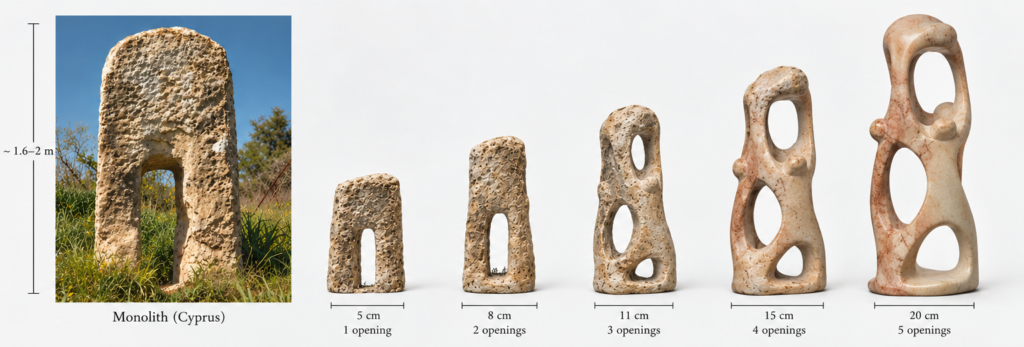
Lesser stones are portable objects, 5 to 25 cm tall. All are made of the same material, though they may vary in shape. What sets them apart from the monoliths is the number of openings: a standing stone usually has a single opening, while a lesser stone may have several, anywhere from one to nine.
Unlike the great monoliths, lesser stones are not bound to a place. They are held privately, passed down through families, and change hands on the antiques market. No systematic record of them exists.
Mechanics
The information below comes from the only known source: a late sixteenth-century Venetian manuscript held at the Biblioteca Nazionale Marciana.
Number of windows. The number of openings corresponds to the number of sites the stone can serve. A stone with three windows fits three sites, but can be placed in only one.
The cradle. Every sanctuary has a base intended to hold a lesser stone. There is only one cradle. Whoever places a stone first claims it; there is physically no room for a second.
Irreversibility. A stone once placed cannot be removed. In the words of the source: “A share withdrawn does not return.”
The circle. The sanctuaries of a single cult form a linked group. As long as even one cradle in the circle holds a stone belonging to another owner, the circle remains open, and the power of the monoliths stays available to all.
Closing. An owner who occupies every cradle in the circle closes it. The power of the monoliths then passes to that owner alone and ceases for everyone else.
Ownership. A stone is bound to a particular owner through a special ritual. The owner may hand the stone to others while retaining ownership of it.
A note on the signs of closing
The source states explicitly that the closing of a circle is accompanied by no observable phenomena: “There will be no thunder, no sign. It will simply stop.”
It follows that the fact of closing cannot be established after the event. The only described means of verification is the omen that appears when a stone is placed into a circle that remains open.